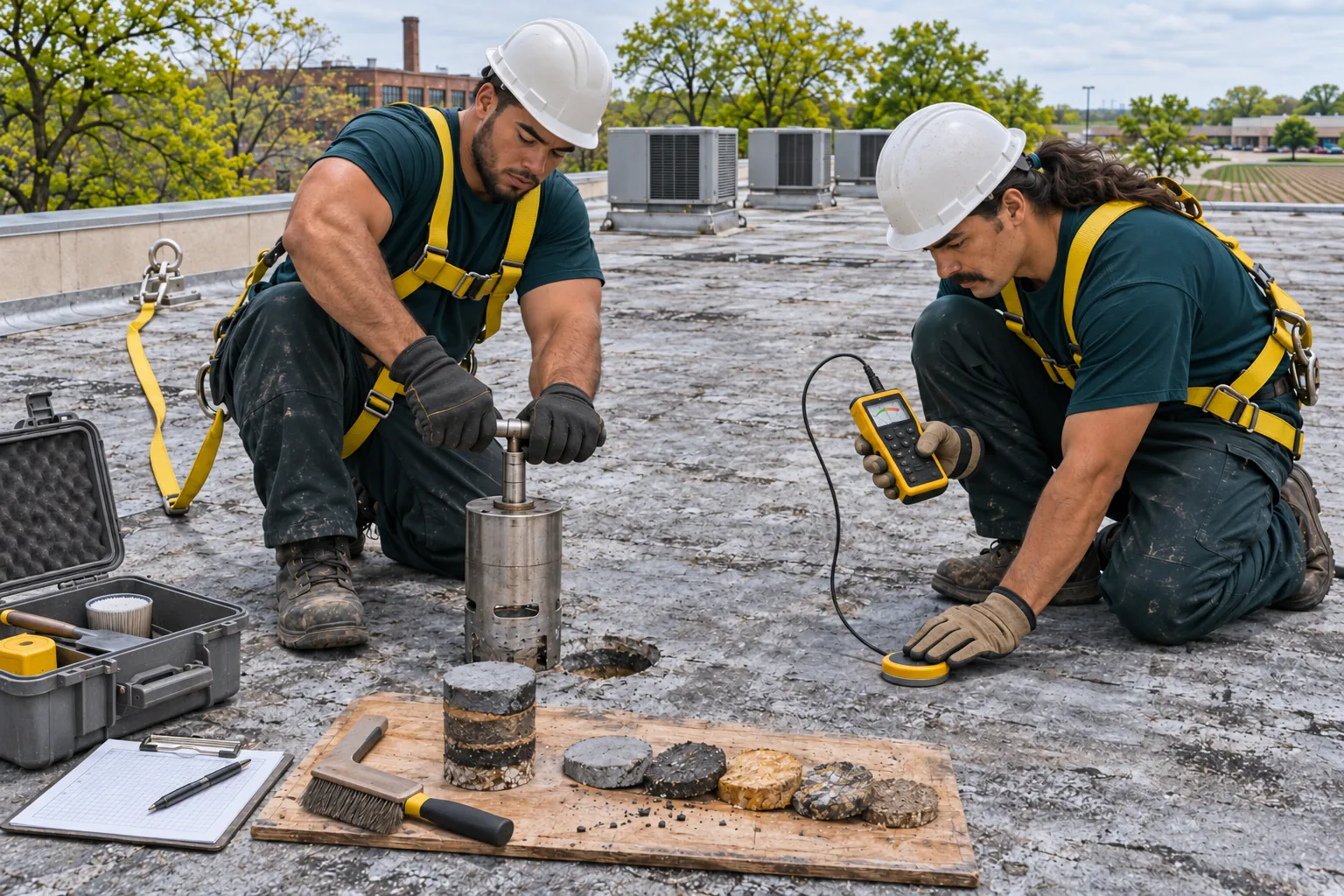
Two roofers taking a core cut and reading a moisture meter on a flat commercial roof

South Bend Commercial Roof Repair FAQ

Answers on Leaks, Repair Costs, Permits, and Nearby Towns

This South Bend commercial roof repair FAQ answers the questions owners and facility managers ask before, during, and after a roof repair.

All Questions

South Bend Commercial Roof Repair FAQ by Topic

The South Bend commercial roof repair FAQ below holds 30 answers in seven groups. Jump to a topic, or read from the top.

Questions

Inspections, Storms, and Repair Costs

Start here for how a repair is scoped, what drives the price, and what happens when water is coming in now.

What Does a Commercial Roof Inspection in South Bend Cover?

We walk the entire roof and check seams, flashings, drains, edge metal, skylights, and every rooftop unit curb, then look at ceilings and the deck from inside where stains show. Moisture readings or core cuts tell us whether insulation is wet.

You receive photos and a written list of repairs, ranked by urgency, with the cause of each problem.

How Is Hail Damage Repaired on South Bend Commercial Roofs?

We start by documenting the damage with photos and impact measurements, which insurers usually request.

Repairs follow the roof type: punctured or bruised single-ply is patched or replaced in sections, metal roofs get damaged fasteners and cracked sealant replaced, and broken skylights, vents, and flashings are swapped. We also check for crushed insulation under the membrane.

What Is Involved in an Emergency Commercial Roof Repair in South Bend?

An emergency repair stops water from getting in until a permanent fix is possible. Crews install a temporary patch, membrane cover, or tarp over the opening and protect interior areas where they can.

Work happens only when the roof is safe to walk. After that, we inspect the full damage and plan the permanent repair.

What Drives Commercial Roof Repair Cost in South Bend?

The roof system, the size of the damaged and wet area, the number of penetrations near the leak, roof height, and access are the main drivers. Detail repairs at drains, parapets, and rooftop units take more labor than patches in open areas.

Winter conditions can add time. A free on-site estimate sets the price.

How Often Should a South Bend Commercial Roof Be Inspected?

Twice a year is a common practice: once in spring to find winter damage from snow, ice, and freeze-thaw, and once in fall to clear drains and seal details before snow arrives.

Add an inspection after any hailstorm or high-wind event. Regular checks catch small seam and flashing problems before they become interior leaks.

Questions

Flat Roofs, Blisters, and Standing Water

Water sits longer on a low-slope roof, so drains, seams, and low spots decide where the leaks start.

What Is the Best Way to Repair a Flat Roof on a South Bend Distribution Warehouse?

Find the leak's true source first, since water travels under membranes before it drips. Then repair with matching materials: heat-welded patches on TPO, primed seam tape on EPDM, compatible plies on built-up or modified bitumen.

Cut out wet insulation under the repair. On long warehouse roofs, fixing drainage often stops several leaks at once.

How Are Blisters on South Bend Flat Roofs Repaired?

Small, intact blisters are monitored rather than opened. Larger or cracked ones are cut, dried, and patched with compatible materials.

Blisters form when trapped moisture or air expands under the membrane in heat. Many blisters across a roof point to wet insulation or weak adhesion, which a moisture survey confirms.

Can Flat Roof Repairs Be Done in a South Bend Winter?

Yes, many can. Temporary patches stop active leaks in cold weather, and some permanent repairs go ahead on dry days.

Adhesives and primers have minimum temperatures, so certain membrane work waits for a milder day or uses cold-weather products. Snow and ice are cleared from the work area before repairs start.

Why Does a South Bend Flat Roof Leak During Heavy Rain?

Heavy rain exposes weak points that light rain does not reach. Clogged drains and scuppers let water rise above flashing heights, ponding water finds open seams, and wind-driven rain enters through coping joints and wall flashings.

We clear drainage, then trace and repair the specific openings. Persistent ponding may need tapered insulation or added drains.

Why Do South Bend Distribution Warehouse Roofs Hold Standing Water?

Long, low-slope roof runs with few drains let water collect, especially where the deck has deflected or insulation has compressed under foot traffic. Debris and ice block drains and make it worse.

Standing water wears membranes and finds open seams. Repairs include clearing and resetting drains, adding tapered insulation or crickets, and fixing seams in the ponding areas.

Questions

Metal Panels, Fasteners, and Flashing

Most metal roof leaks start at a screw, a lap, or a flashing, and each has its own fix.

What Is the Life Expectancy of a South Bend Commercial Metal Roof?

Metal panels often last several decades, but the parts that keep water out, such as fastener washers, sealants, and flashings, wear out much sooner.

Panel gauge and finish, rust at cut edges, and snow and ice sitting at eaves affect service life. Routine repairs to those details keep the panels in service longer.

How Is Metal Roof Flashing Repaired on South Bend Manufacturing Plants?

Rusted or loose flashing at walls, curbs, ridges, and eaves comes off, and we install new matching metal with sealed fasteners. Laps get butyl tape or sealant.

Where flashing meets masonry, counterflashing is set into the wall so water cannot get behind it. Work is scheduled around production so the floor below stays protected.

How Do You Repair a Metal Roof After Hail in South Bend?

We document the damage first, then repair what lets water in.

Dents that do not open the metal often do not leak, but impacts can crack sealant, loosen fasteners, and break skylight panels. We replace damaged fasteners, trim, and skylights, reseal laps, and replace any panels that were punctured.

What Is the Most Common Cause of Metal Roof Leaks in South Bend?

Fasteners. On exposed-fastener roofs, rubber washers dry out and crack, and daily expansion and contraction back screws out of their holes.

Laps, ridge caps, and flashings around penetrations are next. We replace failed fasteners with oversized ones, reseal laps, and repair flashings, which stops most metal roof leaks.

Have a Question About Your Own Roof?

A short call usually answers it. If the roof needs a look, we will set a roof walk and send a written price.

Call Us
Have This Ready
  • The building address
  • Roof type if known
  • What you are seeing inside
  • Photos, if you have them
Questions

Snowmelt, Parapets, and Leak Tracing

A ceiling stain rarely sits right under the opening. These answers cover how water travels and where it gets in.

Why Does a South Bend Commercial Roof Leak After Snow Melts?

Meltwater pools behind ice at drains, gutters, and scuppers, then rises above flashings or seeps through laps that rain never reaches. Freeze-thaw cycles widen small seam gaps through winter.

The National Weather Service has recorded heavy lake-effect snow from Lake Michigan in St. Joseph County, so repeated melt cycles are common. We clear drains and repair the openings.

How Is a Leak at a Parapet Wall Repaired on a South Bend Building?

We check the coping cap and its joints, the face of the wall, and the base flashing at the roof line.

Parapet leaks often come through open coping seams or cracked masonry above the flashing. Repairs include resealing or replacing coping, new base flashing and counterflashing, and sealing cracks in the wall.

How Do Ice Dams Cause Leaks on South Bend Commercial Roofs?

Heat escaping through the roof melts snow, and the water refreezes at colder eaves, gutters, or drains. Water backs up behind that ice and runs under laps and flashings.

Repairs seal those entry points. Better insulation, ventilation, or heat trace at problem drains and gutters reduces how often ice dams return.

Is It Normal for a South Bend Commercial Roof to Leak in Heavy Rain?

No. A sound commercial roof should not leak in heavy rain.

If it does, something has failed or is blocked: a clogged drain, an open seam, a failed flashing, or a coping joint. Heavy rain only reveals the opening. We trace the leak and repair the cause.

How Are Roof Leaks Handled Over a South Bend Medical Office Building?

We protect occupied rooms first with temporary measures, then trace the leak on the roof.

Repairs are scheduled around patient hours, with quiet methods and odor control near rooftop air intakes. Common sources on these buildings are rooftop HVAC curbs, drains, and parapet coping, which we repair with materials matching the roof.

Questions

Plant Roofs and Production Floors

Industrial roofs carry stacks, vents, and heavy equipment, and the people below keep working during the repair.

Do You Offer Industrial Roof Repair Near South Bend?

Yes. We repair industrial roofs in South Bend and in Mishawaka, La Porte, Plymouth, Winfield, and Nappanee.

Plants near those towns are often within reach as well. Call with the building's address and roof type, and we will confirm whether it falls in our service area.

How Are Roofs Over Active Production Floors Repaired in South Bend?

We plan the work so production keeps running. Debris stays on the roof, floors under any deck work are protected, and noisy or odor-producing tasks are scheduled around shifts.

Cold-applied or heat-welded methods are used near combustibles in place of torches. Safety rules and access points are agreed with the plant first.

How Are Industrial Roof Drains Repaired in South Bend?

Debris comes out first, then we inspect the drain bowl, clamping ring, strainer, and membrane flashing.

Cracked bowls and broken clamping rings are replaced, and new membrane is flashed into the drain. Low spots around drains that hold water are corrected so ice does not build up there in winter and block drainage.

How Is an Industrial Roof Leak Traced and Repaired in South Bend?

Industrial roofs carry stacks, process vents, and heavy equipment, so we check those penetrations first.

We look for residue that breaks down membranes, worn paths around equipment, and failed curb flashings. Wet insulation is cut out, matching materials go in, and walkway pads are added where service traffic wore through.

Questions

Permits and the Building Code

Paperwork depends on the scope of the repair. These two answers name the office and the code.

Do Commercial Roof Repairs in South Bend Need a Permit?

The St. Joseph County/South Bend Building Department issues building permits, and its fee schedule sets fees for remodeling, alterations, and repairs by estimated construction cost.

Whether a repair needs a permit depends on scope, so we confirm with the department before larger repairs. Small patches differ from replacing decking or large roof areas.

Which Building Code Applies to Commercial Roof Repairs in South Bend?

Indiana's commercial building code is 675 IAC 13, adopted by the Fire Prevention and Building Safety Commission.

The commission lists the 2014 Indiana Building Code, based on the 2012 International Building Code, as the edition in effect. The local building department enforces it and decides what applies to a given repair.

Questions

The Five Towns Near South Bend

We repair commercial roofs in these five towns as well as in South Bend.

Do You Repair Commercial Roofs in Mishawaka?

Yes. We repair flat, metal, and industrial roofs on Mishawaka commercial buildings, including retail centers, warehouses, offices, and plants.

Each repair starts by tracing the leak and checking for wet insulation. Then we fix the cause, so the same ceiling stain does not come back next season.

Can You Repair a Leaking Roof on a La Porte Manufacturing Building?

La Porte is in our service area, so yes.

Manufacturing roofs there often leak at rooftop units, exhaust stacks, drains, and seams, and lake-effect snow adds meltwater stress at those details. We trace the leak, cut out wet material, and repair with matching materials around the production schedule.

Do You Handle Metal Roof Repair in Plymouth, Indiana?

We do. Plymouth has many metal-roofed industrial, storage, and agricultural buildings. Typical repairs include backed-out fasteners, leaking end laps, worn ridge caps, rusted trim, and broken skylight panels. We replace and reseal those details so water stops entering where metal roofs usually fail.

Do You Repair Flat Roofs in Winfield?

Winfield is in our service area, and we repair TPO, EPDM, built-up, and modified bitumen roofs on commercial buildings there.

Common repairs include open seams, drain flashing, blisters, and damaged edge metal. Wet insulation under the leak is replaced so the repair holds and moisture does not spread.

Do You Repair Storm-damaged Commercial Roofs in Nappanee?

Nappanee is in our service area.

After wind, hail, or heavy snow, we inspect commercial and industrial roofs for lifted edges, torn membrane, open seams, and damaged flashings, document what we find, and make temporary repairs if water is getting in. Permanent repairs follow once the scope is clear.

Still Have Questions After the South Bend Commercial Roof Repair FAQ?

Call or request an estimate. We will answer the question for your roof and price any repair it needs.

Call Us (574) 384-0705